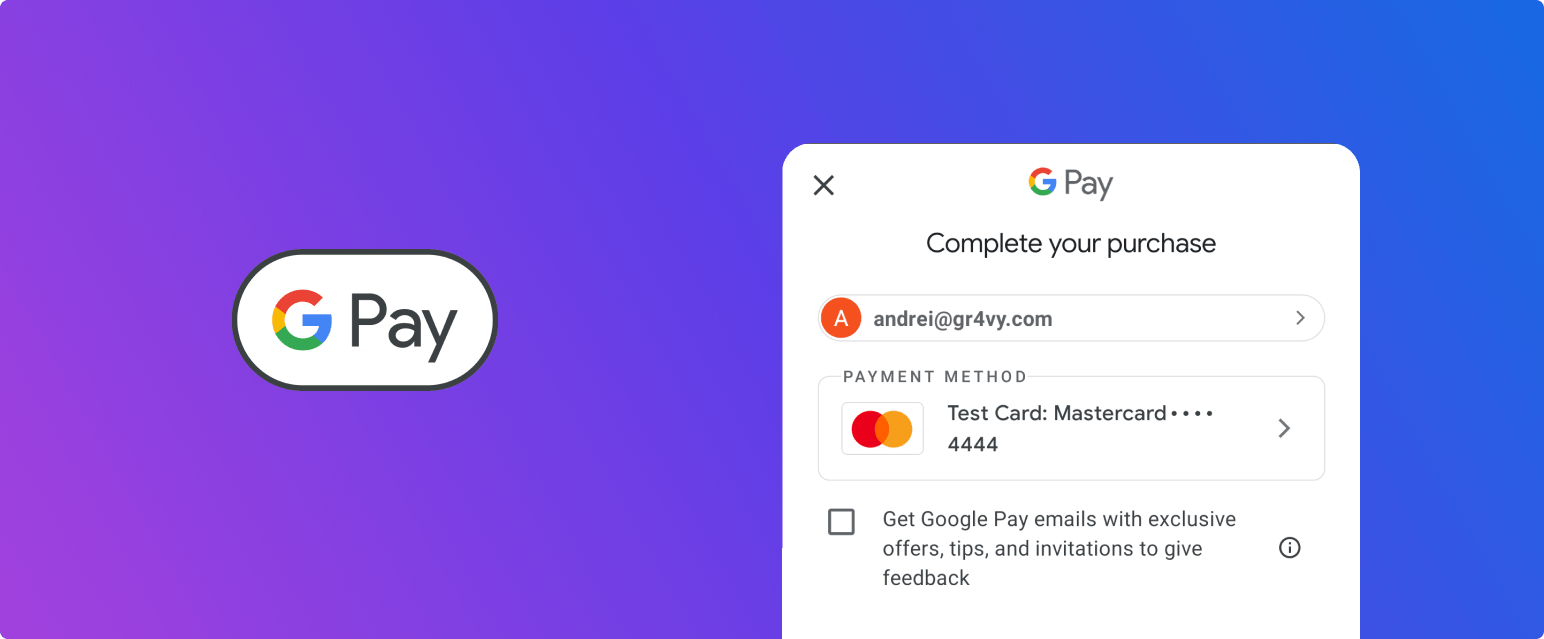
Google Pay is a wallet, not a payment processor. The system integrates with Google directly for
the wallet itself: it runs the Google Pay session and decrypts the payment token, which is why no
Google gateway setup is needed. The result is still a card payment, and one of your card
connections has to authorize it.To accept Google Pay, you need:
A card connection that supports the transaction’s currency and country.
A payment service that accepts decoded Google Pay tokens. Because the system decrypts the
token, it sends decoded device tokens to your payment service instead of encrypted gateway
tokens. Not all payment services support these, and some need the feature switched on, so
check with your payment service provider.
Google Pay payments are routed like any other card transaction, through the
card transactions Flow. To send them to a particular
connection, add a rule with the Card source condition set to Google Pay.
On the web, Google Pay can be easily integrated both with and without Embed. In both offerings, the need to sign up for a Google Developer account has been removed, reducing additional financial and maintenance costs.
On Android, Google Pay can be easily integrated both with and without the SDK. In both offerings, the need to sign up for a Google Developer account has been removed, reducing additional financial and maintenance costs.
A device token (CRYPTOGRAM_3DS), which carries a cryptogram. Gr4vy doesn’t run 3-D Secure for these.
A card saved in the buyer’s Google Account (PAN_ONLY), which is common on the web. Gr4vy processes
these like any other card, so 3-D Secure can apply when it’s turned on for the connection.
When 3-D Secure applies, the transaction returns the status buyer_approval_pending. Send the buyer to
the payment_method.approval_url, even if no challenge is shown, and include a redirect_url when you
create the transaction. If the buyer isn’t sent to the approval URL, the transaction fails when the
approval expires. Embed handles this for you. For integrations without Embed, see
handle a redirect.
Recurring payments are supported on Google Pay in a similar way to how
recurring payments are supported for regular card payments.
Take the first payment with the Google Pay token and store: true, with merchant_initiated and
is_subsequent_payment set to false and a payment_source such as recurring. This stores the
Google Pay payment method.
Charge later payments with the stored payment method id, the same payment_source, and
merchant_initiated and is_subsequent_payment set to true.
A stored Google Pay payment method has no cryptogram, because the cryptogram only exists for the original
payment on the buyer’s device. Later payments rely on the recurring flags and the scheme transaction ID
from the first payment instead, so payment services may decline a later payment that’s sent with the
flags of a first payment.
To facilitate recurring Google Pay payments, your payment service provider needs to
support decoded Google Pay tokens as well as recurring payment flags. Please contact your
payment service provider to enable this feature.
Assistant
Responses are generated using AI and may contain mistakes.