

For detailed information on setting up and configuring specific anti-fraud providers, see the anti-fraud services in the connection catalog. Cybersource, Forter, Riskified, Sardine, and Sift are supported.
How does it work?
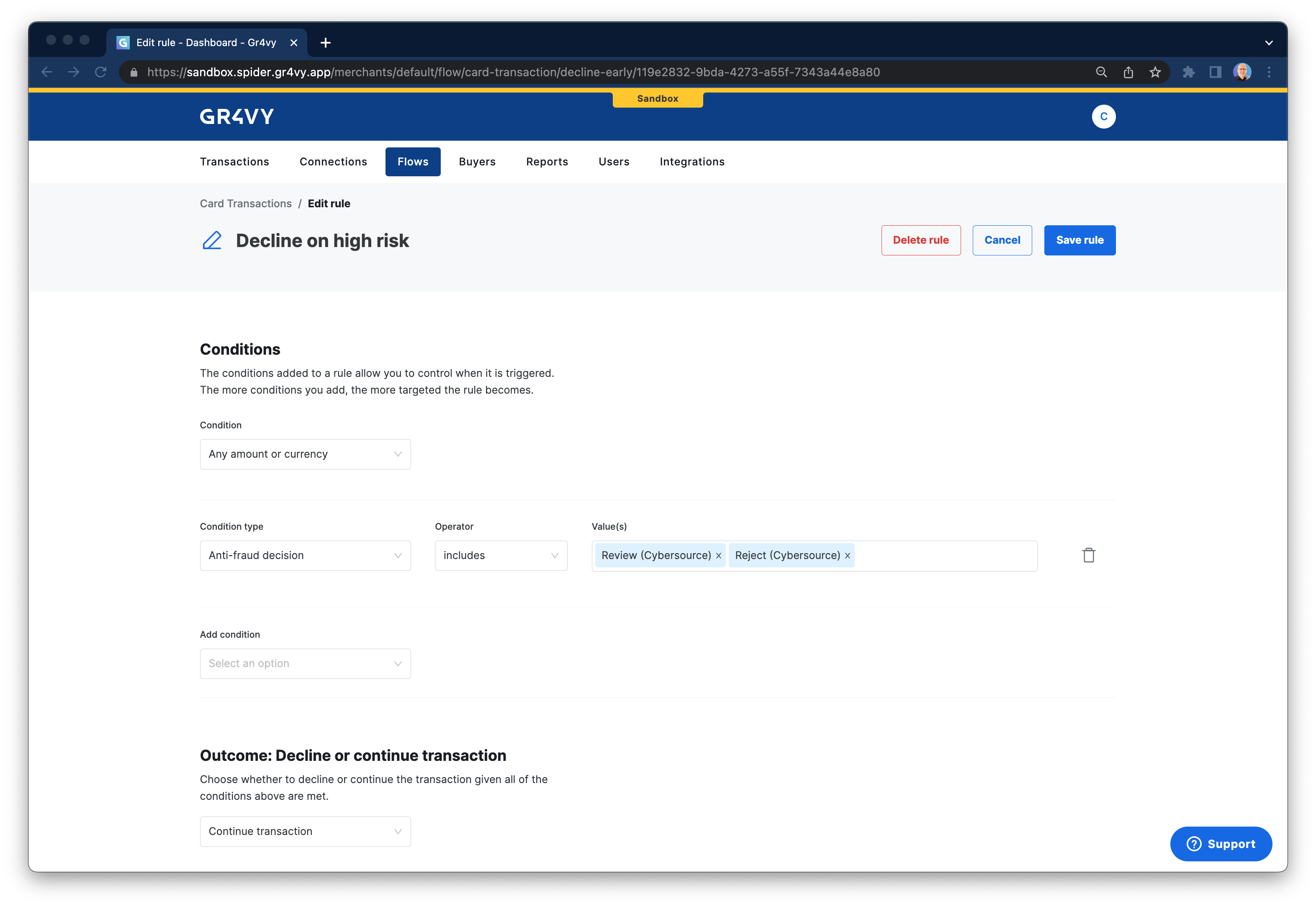
For every transaction, your Primary anti-fraud service is only called once. When a request is made for a transaction, your active anti-fraud provider is only called once, assuming a rule is triggered for which an anti-fraud score or decision is the condition. This feature prevents incurring any extra cost by calling your anti-fraud service multiple times, or calling your service unnecessarily if the rule is not triggered.Connection mode
Each of your configured anti fraud services can be set to a Primary, Silent, or Inactive mode.Anti-fraud decisions
Gr4vy maps each provider’s response to one of the following decisions. The transaction’santi_fraud_decision
field holds the decision from the Primary service, and the Anti-fraud decision condition in Flow matches on the
same values.
anti_fraud_decision is null when no anti-fraud check ran for the transaction. For a review decision, the field
keeps the value review after the review is resolved.