> ## Documentation Index
> Fetch the complete documentation index at: https://docs.gr4vy.com/llms.txt
> Use this file to discover all available pages before exploring further.
# Payment links
> Set up payment links to accept payments from your customers.
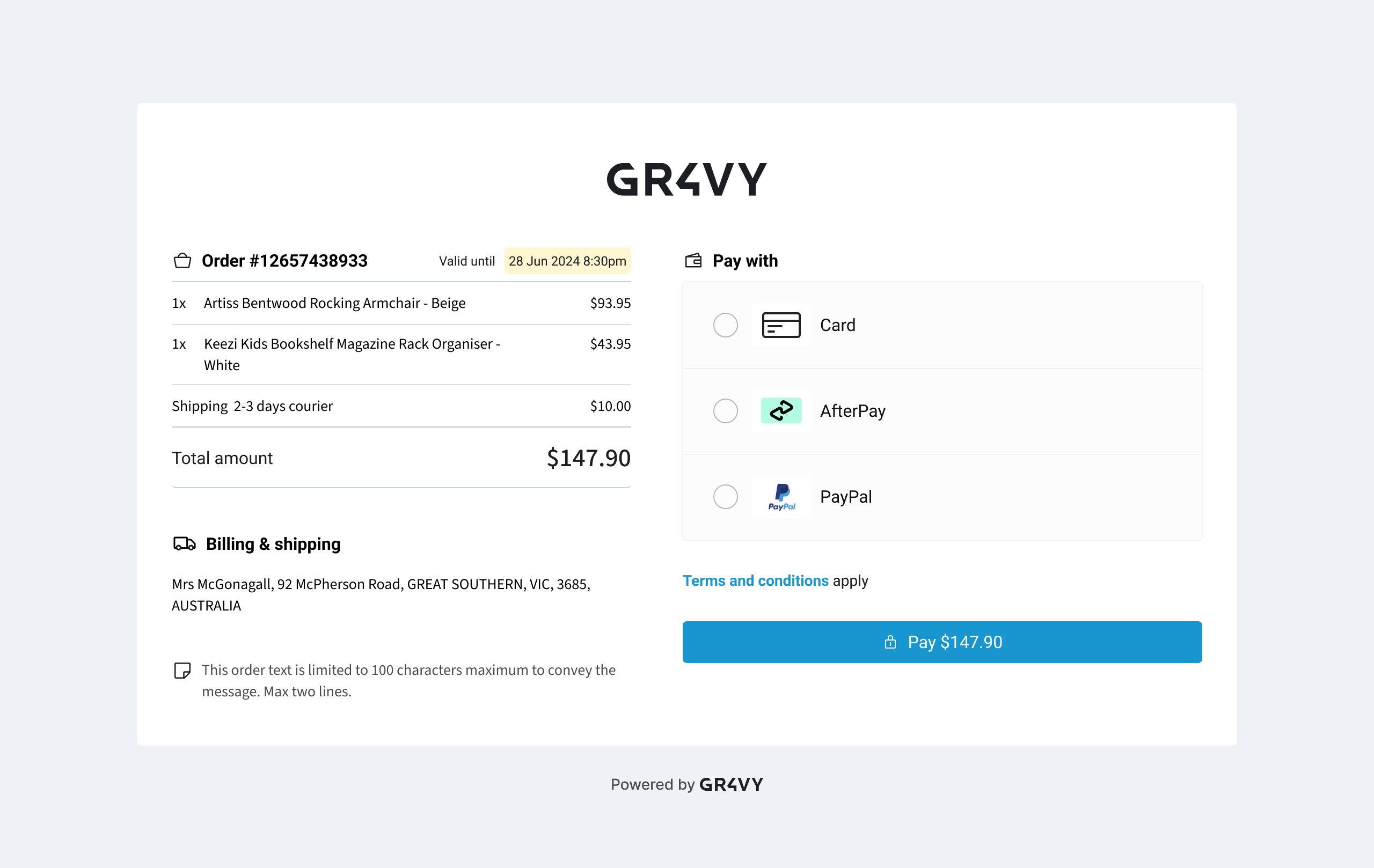 Payment links allows generation of a link, to send to a customer via email/sms/etc,
and then have the customer pay without the need to host a custom checkout.
## Creating a payment link
Use the payment links endpoint to create a payment link with the data displayed on the hosted page. The [payment links API endpoint](/reference/payment-links/new-payment-link) makes it
easy to get create a new payment link.
```json Request theme={"system"}
{
"currency":"AUD",
"country":"AU",
"amount":1000,
"metadata":{
"TypeOfPayment":"purchase",
"Carbon_FootPrint":"10"
},
"cart_items":[
{
"name":"Aloe",
"unit_amount":1000,
"quantity":1,
"sku":"aloe"
}
],
"merchant_banner_url":"https://susies.store/logo.svg",
"merchant_color":"#cf6b6b",
"merchant_name":"Susie's Store",
"merchant_url":"https://susies.store",
"merchant_message":"Thanks for your purchase at Susie's Store!",
"merchant_terms_and_conditions_url":"https://susies.store/terms-and-conditions",
"return_url":"https://susies.store/success"
}
```
The payment link includes the `expires_at`, `status`, and other useful information
used by the hosted page. Make note of the returned `id` as it is used in the next step.
```json Response theme={"system"}
{
"id": "09e90ace-a746-41f5-88d2-8b16335ded97",
"type": "payment-link",
"expires_at": "2025-01-28T14:45:45.929102+00:00",
"amount": 1000,
"currency": "AUD",
"country": "AU",
"status": "active",
...
}
```
The hosted page passes these fields to [Embed](/guides/payments/embed/options#options), which uses them to create the transaction:
* `amount`, `currency`, and `country` (required)
* `buyer`
* `buyer_id`
* `cart_items`
* `connection_options`
* `external_identifier`
* `installment_count`
* `intent`
* `metadata`
* `payment_source`
* `statement_descriptor`
* `store`
These fields control the hosted page itself:
* `expires_at` sets when the link expires. See [expiration](/guides/features/payment-links/statuses#expiration).
* `locale` sets the language of the page.
* `return_url` is where the page sends the customer once the transaction is created, whatever its outcome. Gr4vy appends `gr4vy_transaction_id` and `gr4vy_transaction_status`. Without it, the page shows its own confirmation screen.
* `merchant_name`, `merchant_url`, `merchant_banner_url`, `merchant_color`, `merchant_message`, `merchant_terms_and_conditions_url`, and `merchant_favicon_url` brand the page. When you set both `merchant_name` and `merchant_url`, the success and expired screens show a **Return to** link with your merchant name that opens `merchant_url`.
Payment links don't support airline data. The API rejects a request that includes an `airline` field. See the [API reference](/reference/payment-links/new-payment-link) for the full list of fields.
By creating a payment link, send it to the customer to complete the payment.
## Limit the payment methods on a link
Payment links don't take a list of payment methods to show or hide. To control which methods
appear, set a `metadata` key on the payment link, for example `{"link_type": "invoice"}`, and add a
rule to the [Checkout Flow](/guides/dashboard/flow/checkout#action-select-payment-options) with a
**Metadata** condition on that key. The rule then selects the payment options for those links. If no
rule matches, the page shows all configured and active payment options. Checkout Flow rules apply
to the whole merchant account, not just to payment links.
## Storing a payment method
A payment link can be used to securely store a payment method against a buyer's
profile. To do this, you need to pass both the `buyer_id` and `store`
parameters.
When `store` is set to `true`, the `buyer_id` of an existing buyer must also be
provided. After the payment is completed, the payment method used is
stored and associated with that buyer.
When `store` is `true`, the payment link page only shows payment methods that can be stored,
so some of the options you've configured might not appear.
Currently, it is not possible to use a buyer's existing stored payment methods
to complete a payment link.
When `buyer_id` is provided, the URL of the payment link should be treated as a secret as
it allows anyone the ability to manage payment methods for the associated buyer.
## Find a payment link's transactions
To list the transactions created through a payment link, call [list transactions](/reference/transactions/list-transactions) with the `payment_link_id` query parameter set to the `id` of the payment link.
```http theme={"system"}
GET /transactions?payment_link_id=09e90ace-a746-41f5-88d2-8b16335ded97
```
In the dashboard, go to **Transactions** > **Payment links** and open the payment link to see its transactions.
This documentation is built and hosted on [Mintlify](https://mintlify.com), a developer documentation platform.
Payment links allows generation of a link, to send to a customer via email/sms/etc,
and then have the customer pay without the need to host a custom checkout.
## Creating a payment link
Use the payment links endpoint to create a payment link with the data displayed on the hosted page. The [payment links API endpoint](/reference/payment-links/new-payment-link) makes it
easy to get create a new payment link.
```json Request theme={"system"}
{
"currency":"AUD",
"country":"AU",
"amount":1000,
"metadata":{
"TypeOfPayment":"purchase",
"Carbon_FootPrint":"10"
},
"cart_items":[
{
"name":"Aloe",
"unit_amount":1000,
"quantity":1,
"sku":"aloe"
}
],
"merchant_banner_url":"https://susies.store/logo.svg",
"merchant_color":"#cf6b6b",
"merchant_name":"Susie's Store",
"merchant_url":"https://susies.store",
"merchant_message":"Thanks for your purchase at Susie's Store!",
"merchant_terms_and_conditions_url":"https://susies.store/terms-and-conditions",
"return_url":"https://susies.store/success"
}
```
The payment link includes the `expires_at`, `status`, and other useful information
used by the hosted page. Make note of the returned `id` as it is used in the next step.
```json Response theme={"system"}
{
"id": "09e90ace-a746-41f5-88d2-8b16335ded97",
"type": "payment-link",
"expires_at": "2025-01-28T14:45:45.929102+00:00",
"amount": 1000,
"currency": "AUD",
"country": "AU",
"status": "active",
...
}
```
The hosted page passes these fields to [Embed](/guides/payments/embed/options#options), which uses them to create the transaction:
* `amount`, `currency`, and `country` (required)
* `buyer`
* `buyer_id`
* `cart_items`
* `connection_options`
* `external_identifier`
* `installment_count`
* `intent`
* `metadata`
* `payment_source`
* `statement_descriptor`
* `store`
These fields control the hosted page itself:
* `expires_at` sets when the link expires. See [expiration](/guides/features/payment-links/statuses#expiration).
* `locale` sets the language of the page.
* `return_url` is where the page sends the customer once the transaction is created, whatever its outcome. Gr4vy appends `gr4vy_transaction_id` and `gr4vy_transaction_status`. Without it, the page shows its own confirmation screen.
* `merchant_name`, `merchant_url`, `merchant_banner_url`, `merchant_color`, `merchant_message`, `merchant_terms_and_conditions_url`, and `merchant_favicon_url` brand the page. When you set both `merchant_name` and `merchant_url`, the success and expired screens show a **Return to** link with your merchant name that opens `merchant_url`.
Payment links don't support airline data. The API rejects a request that includes an `airline` field. See the [API reference](/reference/payment-links/new-payment-link) for the full list of fields.
By creating a payment link, send it to the customer to complete the payment.
## Limit the payment methods on a link
Payment links don't take a list of payment methods to show or hide. To control which methods
appear, set a `metadata` key on the payment link, for example `{"link_type": "invoice"}`, and add a
rule to the [Checkout Flow](/guides/dashboard/flow/checkout#action-select-payment-options) with a
**Metadata** condition on that key. The rule then selects the payment options for those links. If no
rule matches, the page shows all configured and active payment options. Checkout Flow rules apply
to the whole merchant account, not just to payment links.
## Storing a payment method
A payment link can be used to securely store a payment method against a buyer's
profile. To do this, you need to pass both the `buyer_id` and `store`
parameters.
When `store` is set to `true`, the `buyer_id` of an existing buyer must also be
provided. After the payment is completed, the payment method used is
stored and associated with that buyer.
When `store` is `true`, the payment link page only shows payment methods that can be stored,
so some of the options you've configured might not appear.
Currently, it is not possible to use a buyer's existing stored payment methods
to complete a payment link.
When `buyer_id` is provided, the URL of the payment link should be treated as a secret as
it allows anyone the ability to manage payment methods for the associated buyer.
## Find a payment link's transactions
To list the transactions created through a payment link, call [list transactions](/reference/transactions/list-transactions) with the `payment_link_id` query parameter set to the `id` of the payment link.
```http theme={"system"}
GET /transactions?payment_link_id=09e90ace-a746-41f5-88d2-8b16335ded97
```
In the dashboard, go to **Transactions** > **Payment links** and open the payment link to see its transactions.
This documentation is built and hosted on [Mintlify](https://mintlify.com), a developer documentation platform.